A Companion to Greek Art by Tyler Jo Smith & Dimitris Plantzos
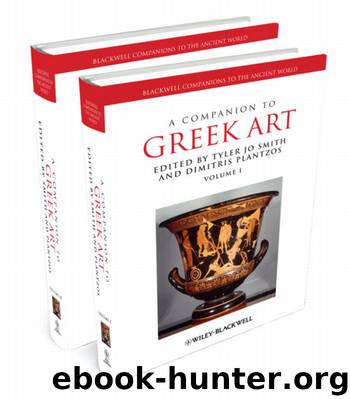
Author:Tyler Jo Smith & Dimitris Plantzos
Language: eng
Format: epub
Publisher: Wiley
Published: 2012-04-02T16:00:00+00:00
21.3 Tyrants, Aristocrats, and their Impact on Art in the Archaic Period
The 7th and 6th c. BC are characterized by intense mobility inside and outside the borders of the Hellenic world and by significant political and social changes. The formation and further development of the majority of Greek city-states played a decisive role in the flourishing of craft production and the shaping of different artistic categories according to local tradition and outside influences (Morgan 2003: 4–104). The appropriate conditions for the implementation of aspiring political and military projects, social acts, financial and religious reforms, and artistic creations were set and supported by several fundamental factors, such as: intense colonial activity, development of Panhellenic sanctuaries as communicational meeting points and places of political bonding and rivalry, establishment of first alliances but also of hostilities, and relations between aristocratic families at both the inner- and the intra-city level (Fisher and van Wees 1998; Dougherty and Kurke 2003; Shapiro 2007).
The early establishment and expansion of athletic games at the significant Panhellenic sanctuaries (Olympia 776 BC, Isthmia 680 BC, Pythia 586 BC, Nemea 583 or 573 BC), as derived from archaeological data and written testimonies, is a good example of the interests and claims of the adjacent cities, which placed them under their protection with the hope of keeping them within their sphere of influence. Functioning primarily as places of contact and confrontation for members of local and foreign aristocracy, they then evolved into places where the political power of the city-states was on display. The construction of treasuries (thesauroi), porticoes (stoai), and other gathering and dining places (leschai and hestiatoria), combined with the dedication of monumental votives that were offered by cities (metropoleis and colonies), had been known ever since the Early Archaic period.
Of similar importance were the numerous personal offerings, which sometimes resembled each other, and at other times varied considerably, in a remarkable range of types, materials, and sizes, according to the cultic demands and the social-financial status of the dedicators (Linders and Nordquist 1987; Whitley 2001: 140–146). A further testimony to the fame that such dedications provided to their donors are the frequent references in the ancient sources and the evidence from many inscriptions on luxurious offerings of kings and tyrants from the Eastern kingdoms and satrapies in the Archaic age – a practice which will be recalled in the Late Classical and Hellenistic periods. In particular, excellence in athletic games was often for the winners a definite means of achieving their political aspirations (e.g. Alkmeon, Kylon) and a reason for triumph in their city, thereby providing an appropriate occasion for private and public dedications.
The early interference of Panhellenic sanctuaries, especially of Apollo’s oracle at Delphi, in the colonial activities of Greek cities is also noteworthy. In the case of Delphi, its role as a Panhellenic religious, political, and cultural center was decidedly marked by the establishment of the Pylian Amphiktyony’s seat at this site, grouping the cities of Thessaly and central Greece probably already in the 7th c. BC.
Download
This site does not store any files on its server. We only index and link to content provided by other sites. Please contact the content providers to delete copyright contents if any and email us, we'll remove relevant links or contents immediately.
| Ancient & Classical | Arthurian Romance |
| Beat Generation | Feminist |
| Gothic & Romantic | LGBT |
| Medieval | Modern |
| Modernism | Postmodernism |
| Renaissance | Shakespeare |
| Surrealism | Victorian |
4 3 2 1: A Novel by Paul Auster(12377)
The handmaid's tale by Margaret Atwood(7757)
Giovanni's Room by James Baldwin(7330)
Asking the Right Questions: A Guide to Critical Thinking by M. Neil Browne & Stuart M. Keeley(5762)
Big Magic: Creative Living Beyond Fear by Elizabeth Gilbert(5757)
Ego Is the Enemy by Ryan Holiday(5417)
The Body: A Guide for Occupants by Bill Bryson(5082)
On Writing A Memoir of the Craft by Stephen King(4936)
Ken Follett - World without end by Ken Follett(4723)
Adulting by Kelly Williams Brown(4567)
Bluets by Maggie Nelson(4548)
Eat That Frog! by Brian Tracy(4526)
Guilty Pleasures by Laurell K Hamilton(4440)
The Poetry of Pablo Neruda by Pablo Neruda(4098)
Alive: The Story of the Andes Survivors by Piers Paul Read(4023)
White Noise - A Novel by Don DeLillo(4006)
Fingerprints of the Gods by Graham Hancock(3996)
The Book of Joy by Dalai Lama(3976)
The Bookshop by Penelope Fitzgerald(3844)
